


The Political Economy of Infrastructure

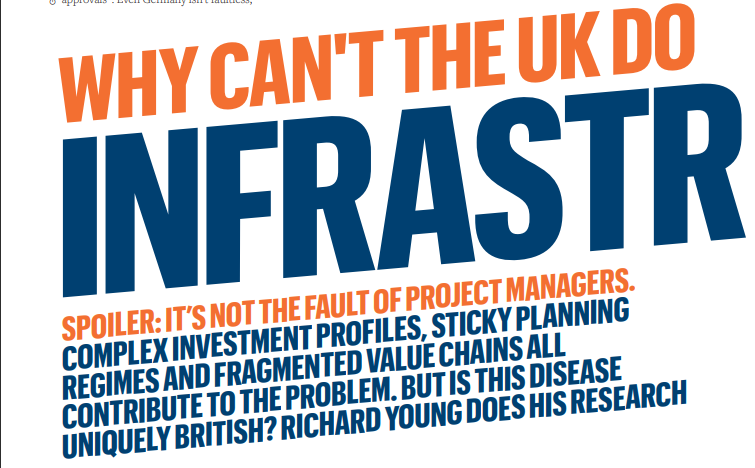
Infrastructure has never been merely an engineering endeavour. It is a political, economic and societal instrument through which governments pursue national development, improve productivity and strengthen resilience. However, its delivery presents an inherent paradox, because infrastructure is usually designed to serve society for fifty to one hundred years or longer. However, the governments responsible for authorising and funding these assets frequently operate within electoral cycles lasting four or five years. This disconnect represents one of the defining governance challenges of modern infrastructure policy.
I mention this because we have all witnessed how most elections have introduced a myriad of possible altered priorities, revised funding commitments, regulatory reform and institutional restructuring; but while democratic accountability remains essential, repeated political intervention more often undermines programme continuity, increases delivery risk and weakens investor confidence. With increasing public discourse frequently attributing infrastructure success or failure to individual political leaders. A change in political leadership should not imply a shift in national policy. Instead, it should present an opportunity to re-evaluate priorities, improve governance, and facilitate the design and delivery of infrastructure. Strengthening the belief that infrastructure policy will remain predictable and long-term is a crucial goal for any new government. Confidence is not the ultimate goal for investors, local authorities, and delivery partners; it hinges on consistency.
However, infrastructure performance depends far more upon governance systems than political personalities. Conversely, where institutions are weak, infrastructure programmes become increasingly vulnerable to political intervention, fragmented decision-making and policy discontinuity. The challenge therefore is not political change itself. The challenge is institutional resilience and to a large extent the UK is a great example of institutional resilience. Over the past decade with six successive administrations, their governments have maintained significant commitments to regional development, energy transition, transport modernisation and digital infrastructure. There have also been well publicised recurring challenges relating to cost escalation, procurement complexity and shifting political priorities. However, these challenges are not uniquely British. Evidently comparable patterns exist in other countries and their common denominator is rarely engineering capability; it is governance. Political uncertainty should not be understood solely as a constitutional phenomenon; from an infrastructure perspective, it represents a governance risk capable of affecting every stage of a project’s lifecycle.
Implications for Project Leadership
Political uncertainty surely does have an impact on project leadership. It practically re-defines it because project leaders of infrastructure projects tend to operate in volatile environments characterised by heightened public scrutiny, changing policy priorities and evolving stakeholder expectations. The role of a project leader in this context usually extends beyond technical delivery. They are expected to naturally evolve into becoming custodians of strategic continuity, by consistently exhibiting political awareness without political dependence.
As a project leader, in order to continue delivering infrastructure that is expected to survive political transition; there are core competences you should be able to nurture and balance such as strategic communication, institutional collaboration, stakeholder alignment and adaptive governance.
Infrastructure That Outlasts Governments
For infrastructure to outlast governments, it must be viewed as an intergenerational investment where its value is never measured by electoral cycles. A key policy question we should be asking is not whether political transitions occur because they are intrinsic to democratic governance; but whether institutions possess sufficient maturity to sustain long-term infrastructure programmes despite political change.
Countries that have successfully answered this question are not necessarily those that are experiencing the greatest political stability. Rather, they are necessarily those that have developed robust governance systems capable of insulating nationally significant infrastructure from short-term political volatility.
Ultimately, infrastructure resilience is not simply an engineering outcome or an investment outcome. It is a governance outcome.
#infrastructure #politics #economy


There has to be a government management system to take care of wastes and ambiquities. In Nigeria and, of course, other African government, democracy is young and unstable. Therefore, the continuity of a particular government that institutes an infrastructure may not sometimes be guaranteed. Therefore there is always need to institutionalise the infrastructure continuity of previous governments. The fact is that, nearly or sometimes the government in power may not succeed to be re-elected into the office in order to complete an infrastructures project initiated by it and its institutions due to fragile political instability. A new government comes in and initiates new infrastructures based on its policies. The previous ones are then abandoned which constitutes waste of resources. This had and has been the trend in Nigeria. I recommend that there should be an institutional frame work for the continuity of infrastructures initiated by previous governments by the successive ones. There has to be a frame work for the development of government infrastructures among the three tyres of government in the country. The National Assembly should enact laws which will be used as instruments towards the road maps for the institution and developments of government infrastructures in the Nation in order to enhance continuity of infrastructures. The existing government Institutions that are “perennial”, the institutions of the Executive arm of government shall work together with the Judiciary arm to manage and maintain the legal instruments to make sure infrastructures or projects institutions and development continuities shall be enhanced in Nigeria. Thank you Sir.