


Strategy and Execution: Project Management’s Most Persistent Failure

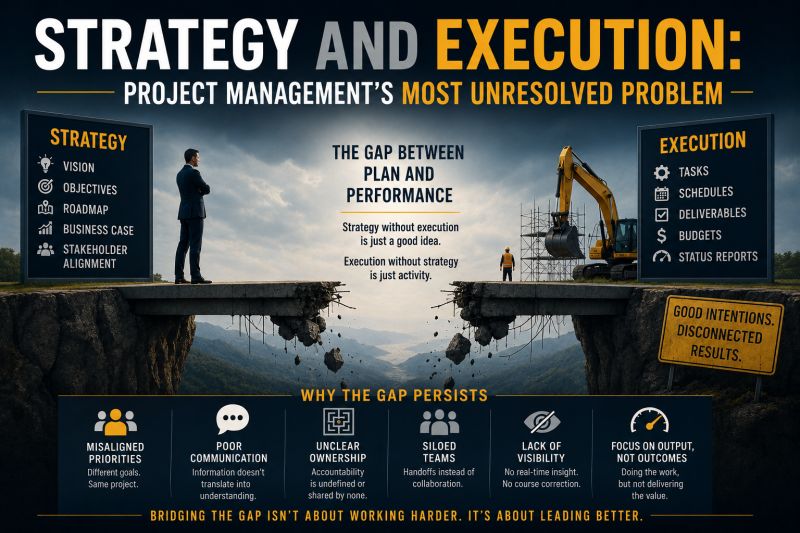
For decades, the project management profession has refined its methodologies, standards, and frameworks. Yet despite these advances, one fundamental problem remains largely unresolved: the disconnect between organisational strategy and project execution.
The profession continues to celebrate projects delivered on time, within budget, and to specification. However, these measures reflect delivery efficiency rather than strategic effectiveness. A project can satisfy every traditional performance metric and still fail to create meaningful organisational value. This raises an uncomfortable question: Have we become better at managing projects than at delivering strategy?
Across both public and private sectors, organisations invest heavily in strategic planning, transformation programmes, and portfolio governance. Yet research consistently demonstrates that many strategic initiatives fail to achieve their intended benefits. Not because projects are poorly managed, but because they are insufficiently connected to strategic intent throughout their lifecycle.
Every project should therefore be subjected to three fundamental questions:
1) Why does this project exist?
2) Why is it essential to achieving the organisation’s strategic objectives?
3) What measurable organisational value or benefit will it deliver?
These questions appear straightforward, yet they are often overlooked once delivery begins. Strategic alignment frequently becomes an exercise undertaken during business case approval, rather than a discipline maintained throughout execution. As priorities evolve, governance weakens, stakeholders change, and delivery teams become increasingly focused on outputs instead of outcomes. This is where project management must evolve.
Closing the strategy-execution gap requires a different form of project leadership. One that integrates governance, benefits realisation, stakeholder engagement, organisational change, and strategic decision-making into the delivery process rather than treating them as complementary activities. Success should therefore be evaluated not by the production of deliverables, but by the extent to which projects realise strategic intent and create sustainable value.
Perhaps the greatest challenge facing the profession today is not improving project management methodologies, but redefining what successful project management actually means. If project management is to remain relevant as a strategic discipline, the conversation must move beyond delivering projects efficiently to ensuring that organisations execute strategy effectively.
How do you ensure that strategic intent remains visible throughout project execution, not just at project initiation; but until benefits are realised?